ITA/ENG
From exploitation to “revenge tourism”: the anatomy of a mindset shift reshaping the rules of global hospitality.
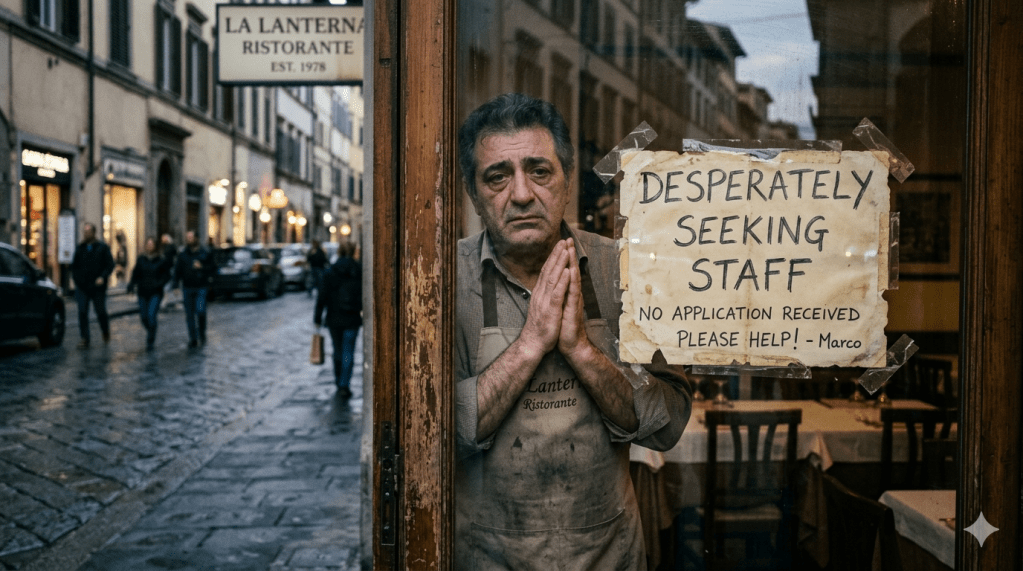
For years, the hospitality industry has been enduring a deep crisis that worries both business owners and operators alike. The increasingly exhausting search for staff within bars, restaurants, and hotels makes national and international markets tremble at the mere thought of losing yet another professional. Too often, however, the blame for this vacancy is shifted onto the younger generations, accused of no longer wanting to work hard, struggle, or learn a trade. But are we truly certain that this labor shortage is entirely their fault? Let’s look at the facts.
For decades, the hospitality world has coexisted with almost non-existent institutional protections. A management system that tolerated base salaries paired with unrecorded hours on the cheap, grueling double shifts, and a personal life reduced to zero—where rest days were cut down to one or, sometimes, none at all—triggered an inevitable reaction. It created a progressive detachment that, in the long run, turned into a genuine “mindset revolution,” pushing people to snub the sector entirely.
The tipping point arrived with the pandemic. The lockdown caused even the most old-school professionals to pause; after years of nothing but work and sacrifice, they tasted a piece of normal life for the first time, leading them to question whether that old lifestyle was truly worth it. It is undeniable: Covid radically changed the approach to work. And if this transformation was clear to us, the “veterans” of the industry, why shouldn’t it be just as clear to the newer generations?
Data in hand, the numbers from recent years confirm that this is not a passing phase, but a profound structural shock:
The Transition Timeline (2020 – 2030)
- 2020 – 2021 (The Trauma): The pandemic caused an immediate loss of 62 million jobs globally (WTTC data). The monthly quit rate reached a historic high of 6.9%. Entire generations of professionals permanently migrated toward sectors with more regular hours and stable pay scales.
- 2022 – 2024 (The Mismatch): The “revenge tourism” phenomenon sent demand skyrocketing, but workers were missing. The vacancy rate fluctuated steadily between 11% and 15% in Europe and North America. Global revenues recovered, but operational staff levels remained hindered by a net deficit of 10-12% compared to 2019.
- 2025 – 2030 (The New Standard): Tourism demand is projected to grow by 3.2% – 3.6% annually, requiring 89 million new jobs globally by 2030. However, the structural vacancy rate will stabilize around 10%. The gap will not close; instead, companies will respond by reducing their average staff size by 15% compared to pre-pandemic models.
Speaking with fellow restaurateurs and venue owners, the exact same detail comes up constantly: today’s youth prefer to opt for part-time contracts, making it explicitly clear that they want to preserve time for themselves.
And what do we do? We criticize them?
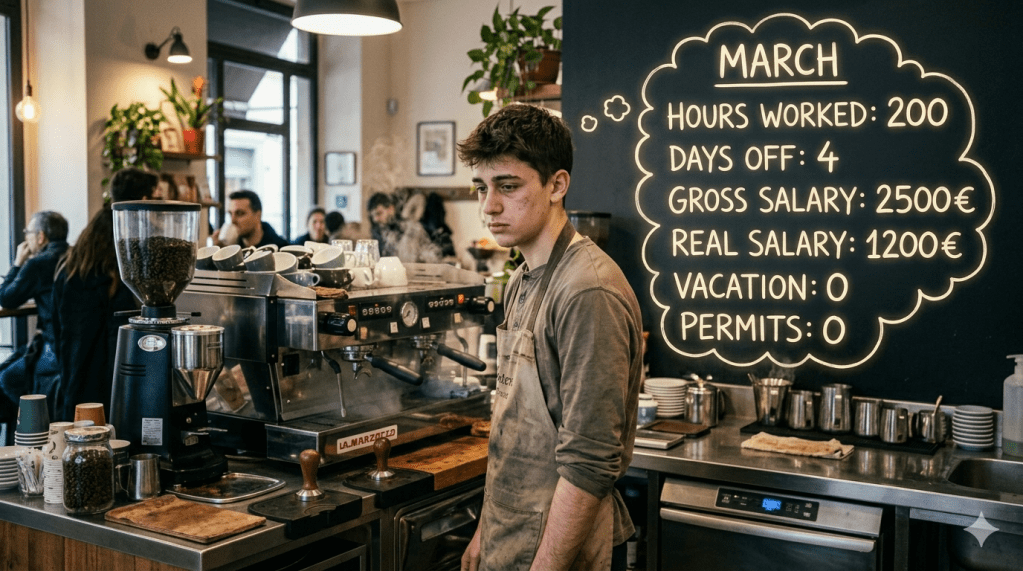
Do we never stop to think that the real motivation lies in a mix of factors: economic issues, the need for free time, generational evolution, and legitimate ambition? Beyond just time, these young people are looking for financial stability and dignity. For too many years, the industry has abused the trap of “zero-hours” or zero-guarantee contracts and precarious employment that prevents someone from renting an apartment or applying for a mortgage. Faced with this uncertainty, a young worker prefers to pivot toward logistics or large-scale retail—where the pay might be similar, but the shifts are predictable and the protections are real.
To this, we must add a profound failure of the training system and a cultural devaluation of the trade. A toxic idea has taken root: that working behind a bar or on the floor is merely a “transitional job” for students or the unemployed, rather than a noble professional career that requires immense technical, psychological, and hospitality skills. If business owners do not offer continuous training and instead treat staff as interchangeable pawns, talented young people with the ambition to grow will, quite rightly, choose to walk away.
If twenty or thirty years ago we had been offered an adequate salary, solid contracts, more standardized working hours, two consecutive days off as a fixed rule, and vacation days and leave just like any worker in other sectors, wouldn’t we be happier today and, consequently, more understanding?
In every economic sector, there comes a breaking point that precedes a rebirth. Perhaps this is exactly what the hospitality industry deserves.
I fully understand the entrepreneurial point of view: the reasons are thousands, from labor costs to taxes, down to the consumer crisis and increasingly tight profit margins. It is a complex chain that feeds a straining, vicious economy. It is also true, however, that in some countries, when planning the opening of a venue, costs are evaluated upfront based on operating hours and customer flows—ensuring a staff size sufficient to cover humane shifts, while providing fair wages and transparent career paths.
Today, the modern entrepreneur must understand that you can no longer operate the way we did twenty years ago. With staff sizes reduced by 15%, survival relies on menu engineering and operational efficiency. We must have the courage to streamline menus, reduce offerings, and rely on advanced preparation in the background (such as pre-batching or lab prep during prep hours) to remove unnecessary fatigue from the few employees on duty, allowing them to focus their energy solely on pure hospitality.
Therefore, before blaming the youth simply because they choose not to follow the old rules of hospitality—whether right or wrong—we must first complete an honest soul-searching process. We need to ask ourselves if the sector didn’t push the envelope too far, forcing a breaking point that, in the end, might just be necessary to reset and save this craft.
Diego Ferrari

