ITA/ENG
Throughout my career—first as a bartender, then as a global ambassador, and today as a beverage industry consultant—I have experienced and analyzed the varying approaches to both national and international events that the bar industry has adopted for years. One of the most common sentiments I encounter when attending certain trade events (not all of them, of course) is that bartenders, brands, and sometimes even the organizers themselves are not entirely satisfied with the results achieved. Let’s break down the most critical aspects of these dynamics, attempting to understand where the bar world is heading today and what the future trends will be.
The FOMO Trap vs. Elite Hubs (The illusion of presence)
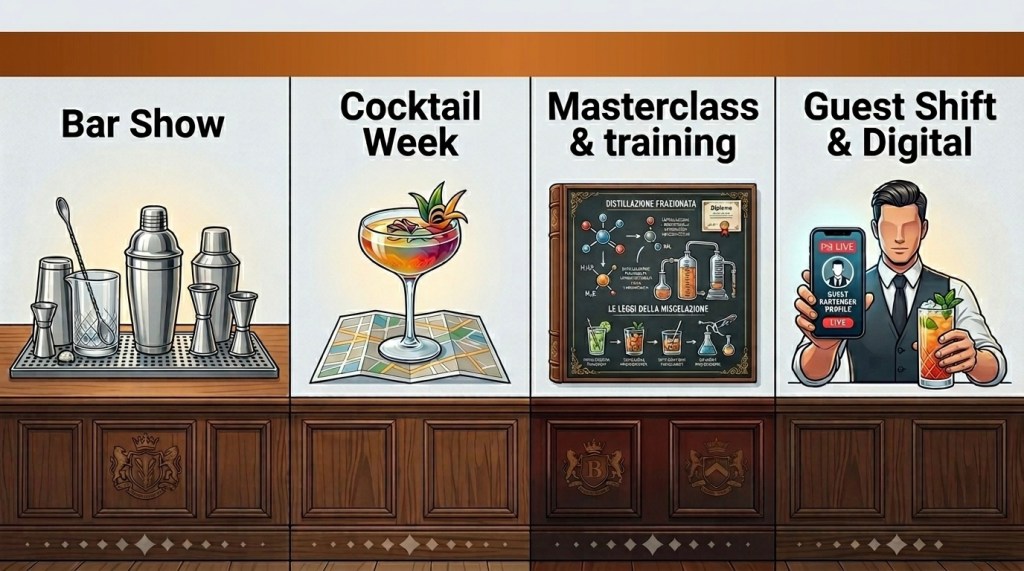
In recent years, the bar industry has seen the number of events grow tenfold, with international Bar Shows and Cocktail Weeks well exceeding one hundred over the past decade. This saturation has forced a drastic choice and created a completely fragmented market approach: today, brands face a strategic crossroads when allocating their budgets.
On one hand, we find brands driven by FOMO (Fear Of Missing Out). Terrified of showing signs of weakness to competitors or being forgotten by the market if they choose not to participate, they invest massive amounts into a myriad of local activities and micro-events. The result? A heavy presence lacking any real commercial strategy, which often translates into zero financial return or yields purely image-based rewards.
On the other hand, some brands apply a surgical selection process. Well aware of market fragmentation, these brands choose to invest exclusively in a very select few activities—such as the two or three major global hubs per year—that guarantee concrete, measurable results and a real ROI. They prefer not to get distracted by the background “noise” of local micro-events that saturate the market—contexts that true decision-makers (buyers, major distributors) prefer to avoid, leaving room only for self-referential dynamics among industry insiders.
The contrast is stark: those who waste budget out of fear (FOMO) versus those who optimize for performance (Selection).
The Third Way: The Opportunity of Emerging Markets
However, there is a strategic alternative that is often underestimated by those who limit themselves to this binary choice: looking beyond mature markets. Tracking and investing in Bar Shows, Cocktail Weeks, or masterclasses within “emerging” countries and markets represents one of the most forward-thinking moves a brand can make today. In these regions, saturation is still far off, and the attention span of both professionals and enthusiasts is extraordinarily higher. Participating in an event in a fast-growing country means finding a receptive, curious audience genuinely interested in discovering new products. Consequently, feedback is immediate, and the ROI—given that activation costs are often lower than in traditional markets—proves to be significantly higher and delivers a powerful, long-term impact.
My intent is not to offer destructive criticism toward those who, with hard work and dedication, believe and invest in creating these activations. Rather, it is an objective analysis that anyone—whether on a brand’s marketing side or the organizational side—is forced to make when confronted with an excessively low ROI or when struggling to secure new sponsorships. Traditional markets are saturated, and the question we must ask ourselves is whether the future will still be driven by these events or if we should expect a radically different approach.
The Hidden Iceberg (The sunk costs)
One of the most common mistakes in budget planning is calculating the cost of an event by looking strictly at the registration fee and the exhibition space.
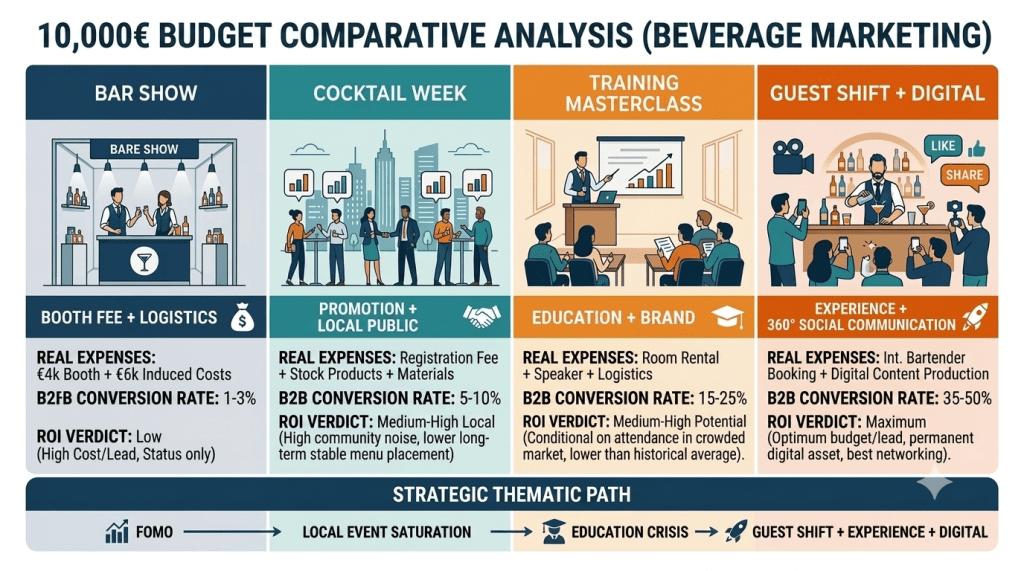
The real financial drain hides within the 360-degree ancillary expenses: staff travel and transport, accommodation rates inflated during trade show days, complex shipping logistics, setup labor, and the hundreds of sample bottles given away. If these incidental costs double or triple the initial investment, exhibiting at the trade show risks becoming economically unsustainable. A thorough cost analysis that considers all surrounding variables is therefore highly recommended, as it drastically reduces errors in budgeting and calculating the respective return on investment.
Last but not least, within these major global events, many brands invest in renting dedicated rooms for masterclasses centered on their product. But how much traction do these activations actually get today?
The Metamorphosis of the Masterclass (How to avoid failure)
Simply talking about the brand and the bottle today is equivalent to drawing water with a sieve. Education has become incredibly difficult terrain: saving for a very select few brands and certain historic, major Academies that boast a fiercely loyal audience, the rest of these activations suffer from fierce competition.
Today, a masterclass only makes sense if it delivers highly valuable educational content (global macro-trends, deep category history, market insights). Furthermore, it can no longer fly solo: without on-the-ground support from distributors, sales reps, and PR agencies to physically bring the target audience to the room, the risk of facing an empty or semi-empty venue is extremely high. This scenario completely wipes out the ROI, unless it is a specific strategic investment by an emerging company that simply needs to build brand awareness—a reasonable goal, but one whose success is never guaranteed.
Brands frequently spend enormous amounts to speak exclusively to an audience of professionals (bartenders) who, compared to 15–20 years ago, are far more educated, prefer to dedicate their free time to things outside of traditional training, and, particularly among the younger generation, display a sharp decline in interest regarding long-term careers in the hospitality industry.
For all these reasons, it has become far more profitable today to invest in activations capable of engaging the final consumer, the enthusiast, and the curious drinker. This target brings immediate popularity to the brand, generates organic word-of-mouth, builds customer loyalty, creates a product culture, and amplifies 360-degree social media visibility. Shifting the focus to the evolved consumer means building authentic, solid, and unfiltered brand equity. A strong market positioning will, in turn, naturally attract the professional, thereby generating even greater value and interest.
The Strategic Mix: Guest Shifts, Digital, and Media
Another widespread activation among brands is the Guest Shift featuring international bartenders or prominent figures from the bar industry—a tool originally designed to attract both the high-level trade community and curious consumers. Today, however, many are asking a crucial question: are these activities still truly profitable for bars and brands, or are they losing their momentum?
As previously mentioned, to optimize the investment and avoid reducing it to a superficial vanity exercise, the key is synergy. Pairing a nightly Guest Shift with an afternoon masterclass focused on an intriguing, cross-functional, and engaging topic allows brands to capture not just industry professionals, but a much broader audience. When this mix is paired with strategic social media support to ensure a permanent digital narrative, the visibility of the brand, the host venue, and the featured bartender extends far beyond the four walls of the bar and the single night of the event, maximizing the return on investment.
Yet, doubts about whether it is “truly worth it” remain widespread, especially given the sheer amount of effort required.
The Consultant’s Perspective: An Ecosystem of Positioning and Loyalty
Anyone who actively organizes or participates in a Guest Shift knows full well that the goal has never been the simple cash register intake at the end of the night. There is so much more behind these activations: they are driven by a structured Marketing and PR vision capable of generating real, tangible value across multiple levels.
For a brand, it means investing in visibility and, above all, forging and cementing crucial international relationships. Simultaneously, for the host venue, these nights represent an extraordinary tool for fidelizing regular customers, who are offered an exclusive, international experience right in their go-to neighborhood bar.
Granted, behind the scenes, there is a lot of hope, immense organizational effort, and significant financial investments made by the bars themselves to fly in international guests and high-profile figures. But it is precisely this virtuous cycle that makes the difference: building rock-solid human and commercial relationships between sponsor brands and foreign peers becomes the gateway to getting noticed on the global bar industry radar, offering venues a concrete opportunity to compete and earn a spot within the world’s most prestigious international industry rankings.
The Media Crossroads: Is Investing in Trade Magazines Still Worth It?
Once upon a time, traditional media was the only available option; today, it is an investment that must be carefully recalibrated. Print media has lost its immediate commercial reactivity, but it maintains a high institutional value, consolidating heritage and B2B reputation in front of major distributors. Furthermore, those belonging to older generations still appreciate the tangible value and prestige of print magazines.
Today, this reality naturally and progressively collides with the digital universe. Digital channels often offer better target profiling, but they compete directly with the proprietary channels of brands and individual professionals (the industry’s Key Opinion Leaders). In this space, investments move fluidly and almost daily: activations with online publications, AI-supported video content, and Reels featuring industry influencers are all activities that diversify the investment, returning a measurable ROI through clear metrics such as insights, reach, views, and engagement.
Naturally, each of these activations requires a completely different financial commitment in terms of budget. Let us now look at a simulation based on a standard investment of €10,000 distributed across four of these strategies, to understand in concrete terms the relationship between ROI and the real benefits they can guarantee a company.
Diego Ferrari

