ITA/ENG
In my previous article, we analyzed in detail the financial and strategic effectiveness of the key activities that set the rhythm of the global bar industry: Bar Shows, Cocktail Weeks, masterclasses, and guest shifts. We dissected costs, visibility, and conversions, reaching a clear conclusion: in historically mature markets, high saturation and astronomical activation costs are progressively eroding profit margins and the long-term effectiveness of investments.
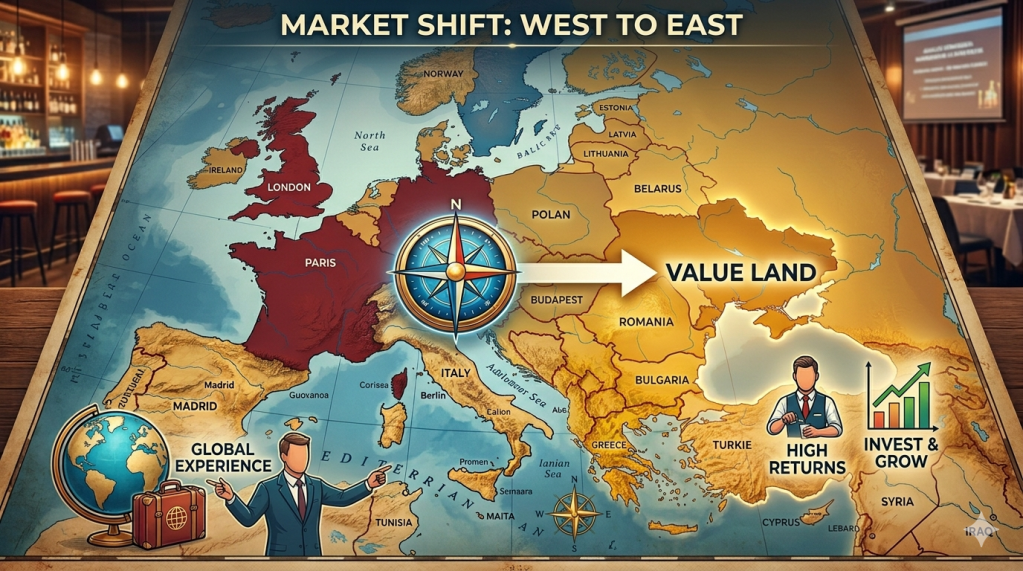
Today, drawing on a professional journey that has taken me to over 60 countries, I want to take a step further. If we look at the geopolitical beverage map through the eyes of a corporate consultant, the compass no longer points toward the usual Western European capitals. The true value multiplier—the land where investments in guest shifts, events, and product positioning currently offer the highest commercial returns—is to the East: in the Balkans and Eastern Europe.
The Paradigm Shift: Emerging Consumption vs. Saturated Markets
While Western Europe faces a phase of stagnation, macroeconomic data from the past five years (2021-2025) and strategic projections for 2026-2030 highlight a profound structural transition in these very regions. The market is no longer driven solely by high-proof domestic volumes, but by progressive selective premiumization and a strong push toward intentional moderation. This transition is creating vast market opportunities for forward-thinking brands.
Eastern Europe: The Urban Moderation Revolution
In Eastern Europe (Poland, the Czech Republic, Slovakia, Romania, and the Baltic States), we are witnessing an extraordinary phenomenon in major metropolitan centers. While rural areas maintain consumption levels anchored to traditional spirits, urban Gen Z and Millennials are driving exponential growth in the Low & No Alcohol segment, estimated at a CAGR of +8% to +10% through 2030.
Stringent legislative factors—such as zero-tolerance policies for driving under the influence—combined with a strong health-conscious trend, are making high-end NoLo products a commercial necessity. Investing today in a technical masterclass or the launch of a non-alcoholic product in Warsaw, Prague, or Bratislava guarantees a level of attention and adoption from local bartenders that is infinitely higher than in saturated markets like London or Berlin.
The Balkans: The Low ABV Path and the Tourism Showcase
The Balkans represent a unique model, where a strong cultural identity tied to local spirits (such as Rakija) is blending with elite international tourist flows. Along the coasts of Croatia, Montenegro, and Albania, mass summer tourism acts as a formidable trend accelerator—a true temporary showcase that influences the Horeca sector of the capitals during the winter months.
Here, the 2026-2030 forecast sees a CAGR of +5% to +6%, driven not so much by “Zero Alcohol,” but by Low Alcohol (3-7% ABV). The deep-rooted culture of outdoor daytime aperitivos is evolving toward longer, fresher, and more structured drinks, creating fertile ground for the activation of premium spirit brands that know how to tap into this specific social ritual.
The Regional Driving Force: Greece
To fully understand the explosion of the Balkans, it is necessary to look at the historical market that is acting as a genuine catalyst and cultural beacon for the entire macro-region.
Greece: The Engine of Balkan Mixology Greece needs no introduction, but its current strategic role goes well beyond national borders: it is the true geopolitical engine of Balkan mixology. With a consolidated domestic market and the strength of global institutions like the Athens Bar Show, Greece confirms its leadership year after year. The activism of the Greek bar community, consistent masterclasses, and international-caliber hospitality do not remain isolated; Athens acts as a natural anchor, inspiring, training, and capturing the flows of bartenders and investments pouring across the entire Balkan peninsula.
Eastern Europe: Top-Tier Cities and International Activations
Eastern Europe is no longer a periphery of mixology, but an open-air laboratory where two cities, in particular, are catalyzing the interest of global professionals thanks to high-profile bars and prominent events.
- Prague (Czech Republic): The Forge of Education The Czech capital is making a forceful statement on the international scene. We no longer speak of Prague as a destination for volume, but as an urban hub rich in top-tier bars and targeted activations. A shining example is the Bar Education Symposium, an event that attracts growing global interest each year, demonstrating the technical maturity and pulling power of the local bar community.
- Bratislava (Slovakia): The Danube Stage Further south, Bratislava is consolidating its position as a strategic hub in Eastern Europe. The Slovak capital hosts the Mirror Hospitality Expo every year, a benchmark event capable of attracting the biggest names in international mixology. It is proof of how the local scene is hungry for training and ready to engage on equal footing with major global trends.
- Bucharest (Romania): The BRIFT Stage and National Excellence Romania is experiencing overwhelming growth, and Bucharest is its undisputed epicenter. The turning point for this market is BRIFT, a rapidly expanding national annual event. BRIFT has the great merit of gathering a bar community from across Romania, characterized by extremely high quality and technical standards. For an international brand, activation within this bar show offers commercial penetration and brand-image returns in a highly receptive and dynamic domestic market.
- Budapest (Hungary): The Elite Cocktail Bar Showcase Moving to Hungary, Budapest stands out as one of the most sophisticated capitals in the entire region. The city hosts a scene of marvelous cocktail bars, characterized by global concepts, ingredient research, and impeccable aesthetic elegance. These are structured operations, fully worthy of sitting permanently in the most prestigious international rankings. Investing in Budapest today does not just mean generating volume; it means linking your brand to a circuit of world-class premium hospitality.
- Kyiv (Ukraine): One of the Most Surprising Bar Shows Last, but certainly not least, is the mention of the Kyiv Barometer. For those who have never had the chance to visit, I consider it one of the best Bar Shows in the world. Even in a country at war for years, this event continues to exist with an incredible format, attracting not only excellent bartenders from across the country—and, before the conflict, from around the world—but also cocktail enthusiasts who filled the rooms with enthusiasm for every masterclass.
The Balkans: New Capitals and the Future of Mixology
When we talk about greater commercial yield and an extraordinary level of hospitality, the most responsive answers come from the urban realities of the Balkans, where activism and events are redefining standards.
- Tirana (Albania): Ready for Europe Every year, the Tirana Cocktail Fest hosts dozens of key figures from the mixology and bar world, sharing Albanian culture with pride and great style. This activity has solidified the presence of an important hub dedicated to mixology, which year after year trains and enriches an audience that extends far beyond national borders.
- Belgrade (Serbia): The Hub of Excellence In my professional opinion, Belgrade is currently one of the cities with the highest level of cocktail bars and activations in Europe. The Serbian capital expresses cutting-edge mixology, where the technical competence of bartenders is matched by an innate sense of hospitality. This status is certified by benchmark national and international events: the Belgrade Cocktail Fest, a vital annual event that hosts bartenders from the world’s most influential bars, and the Riddle Cocktail Week, another major urban activation moment. For a brand, planning a guest shift in Belgrade during these events means connecting with a community that guarantees an efficacy in image conversion and real sales significantly higher than in traditional Western markets.
- Skopje (North Macedonia): A Reality to Watch If Belgrade represents the consolidation of emerging excellence, Skopje is clearly positioning itself as one of the next realities on the international map—an outpost with high potential still waiting to be explored. The capital of North Macedonia is recording the first, very important signs of an internal blooming of its bar industry. Venues are beginning to invest in research, and the technical curiosity of local bartenders is vibrant, making it a perfect spot for preemptive positioning strategies.
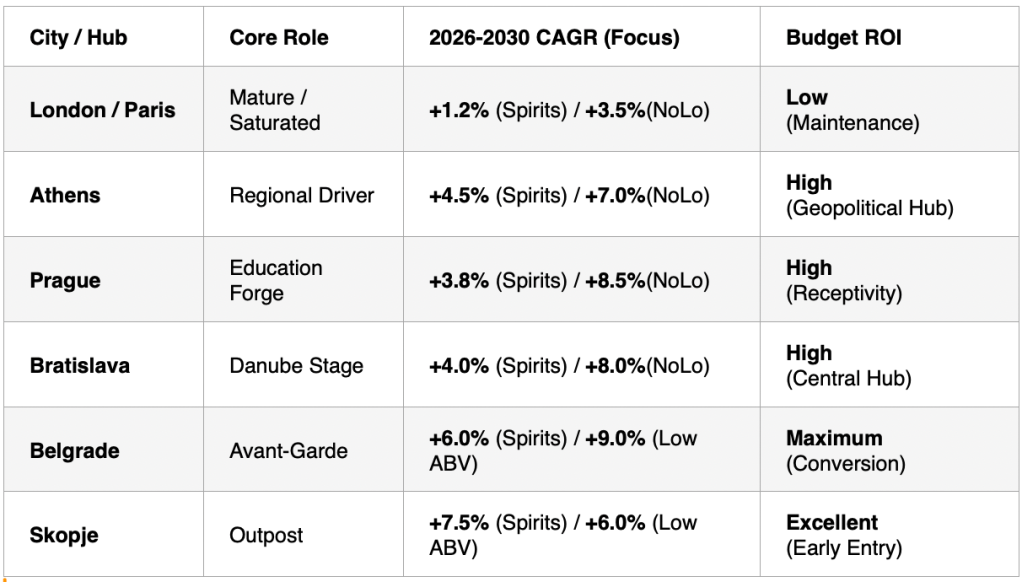
Strategic Overview: Market Comparison (2026-2030 Projections)
Here is the benchmark of six urban clusters selected for their cocktail bar density, tourist flows, and potential for strategic activation in 2026-2030.
Conclusions: Where to Invest?
The success of an activity in the bar world is measured by the ability to generate lasting relationships, price positioning, and real market share. Continuing to focus promotional budgets exclusively on the traditional squares of Western Europe is a defensive strategy and, often, an economically inefficient one.
The Balkans and Eastern Europe—driven by the proven engine of Athens—offer the most precious ingredient for a brand’s success: authentic attention. Whether it is capturing international interest in Prague and Bratislava, leveraging the resonance of a Tirana Cocktail Week or the Belgrade Cocktail Fest, or planting seeds early in Skopje to claim the status of the next mixology reality, the future of the bar industry is being written in the East. It is time to update your investment map.
Diego Ferrari

