ITA/ENG
In the past, embarking on a career as a barista or bartender was primarily a matter of basic practical knowledge. While I am not familiar with the evolutionary path of this role in every country, in Italy many professionals—unfortunately even today—have limited themselves to performing the craft in a basic or, at best, purely technical manner. However, as in many other sectors, if the work is not deepened, diversified, and evolved, professional growth comes to a standstill.
For years, “apprentice-style” learning—based on observing elders without a structured method—generated a dangerous stagnation in the industry. Often, ego blocks the desire to learn: one becomes convinced they already know everything, viewing new teachings as a waste of time. There is no greater mistake.
Analyzing the market—and you don’t need to be an engineer to do so—we notice that many businesses do not generate sufficient margins to survive. We can discuss the causes for hours: tax pressure, rising costs, lack of liquidity, or bad luck. The fact remains that many businesses risk closing every day. Part of the blame lies specifically with the lack of training or a poor understanding of a key concept: knowing how to make an excellent coffee or an innovative cocktail does not, on its own, guarantee the success of a company.
It is commendable that more enterprising colleagues study new techniques to stay at the cutting edge. However, you can be the best mixologist in the world, but if you don’t know how to broaden your perspective and “step out from behind the bar” (metaphorically speaking), you will never grow.
Unlike 40 years ago, today we have infinite knowledge at our disposal: specialized courses, master’s degrees in bar economics and management, free masterclasses on products or drink costs. We have every possible tool, including Artificial Intelligence which facilitates research and improves communication.
In my career, I have met thousands of mediocre bartenders, hundreds of trained professionals, and dozens of incredible talents. But “multitasking” profiles are very rare: those for whom the cocktail is only the final piece of a complex mosaic, executed with excellence but integrated into a broader vision.
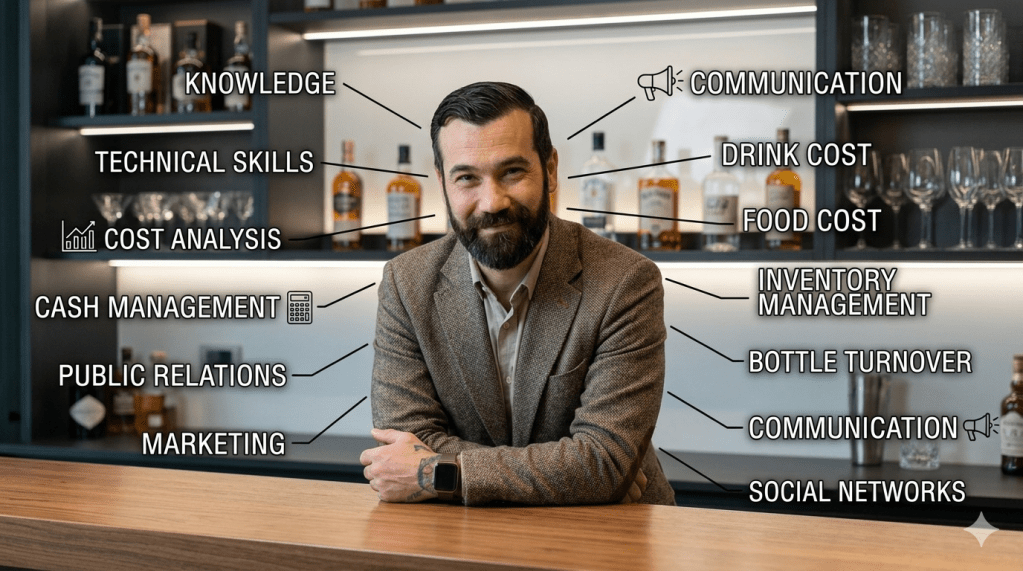
Today, being a bartender or a barista means aiming for the next level: you must become a Bar Manager if you truly want to grow the business. These figures must be able to speak different “languages.” I am not just referring to foreign idioms—essential for hospitality—but to the ability to adopt the right tone of voice with brands, the trade press, colleagues, and the public. Speaking with many industry journalists, it has emerged that bartenders often take ages to respond to interview requests or simple drink recipes for an article, thereby losing the opportunity to appear in the magazine. Knowing how to express oneself correctly and with the right timing is vital: if you aim to make your brand, your name, or your venue better known, this aspect is essential. Furthermore, this skill will help you share research and recipes, eventually opening up opportunities to hold a masterclass, speak on a stage, or who knows… maybe write a book like I did.

Thinking outside the box is the real key. I have known world-class bartenders who, when asked to create a slide presentation or tell their story on a stage, found themselves totally unprepared. Added to all this is the fundamental competence: economic management. Understanding food & drink costs, analyzing suppliers, managing inventory, monitoring turnover and product rotation, and handling social networks and the cash register.
I understand that some may be skeptical, but reflect on this: unless it is your only goal, you will not stay behind a bar counter forever. The need to evolve will come and, without these foundations, the leap in quality will be impossible.
Study, apply yourselves, train. Be the architects of your own future. Remember: if the company you work for earns and prospers thanks to your contribution, it will be in their primary interest to keep you close.
Diego Ferrari

