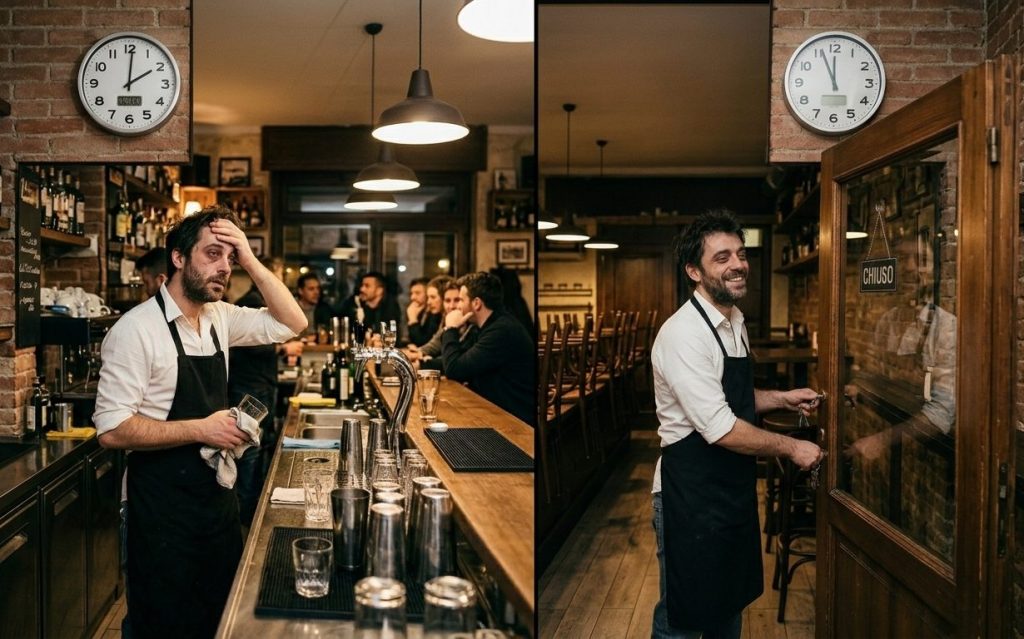
AI image generated
ITA/ENG
May 5, 2023. Even though some countries ended their state of emergency much earlier, three years have officially passed since the World Health Organization declared the end of the pandemic.
As we all know, hospitality was one of the hardest-hit sectors. Rigid restrictions in many countries completely halted business activities, and being forced into lockdown meant people experienced a totally different way of living for a prolonged period.
So, what has fundamentally changed in the F&B world across bars, restaurants, and hotels? How heavy was the economic hit? And how have both industry professionals and everyday guests modified or evolved—because it has indeed been an evolution—their way of going out, consuming, and being part of this industry?
From day zero of COVID to May 5, 2023, the pandemic cost the F&B and hotel sector roughly 3.2 trillion dollars globally, wiping out over 35 million jobs.
Yet, those losses aren’t the only ones that impacted hospitality. Around 1.5 million businesses worldwide closed down during COVID. Many others, just to keep their heads above water, took on subsidized loans or drained a lifetime of savings. And they paid the real price later on…
Hardly anyone seems to be noticing this “wave of return” effect: the post-pandemic three-year period is showing significantly higher closure numbers than the three years prior to the pandemic.
A cluster of factors—not just the ones mentioned above, but also inflation, surging energy costs, squeezed margins, staff shortages, and shrinking purchasing power—have all contributed to reshaping our world.
On the operator side, the pandemic forced a period of deep reflection… Today, we see more and more people across different generations realizing that personal time and family life are actual necessities. I’ve pointed out time and again that hospitality had—and still has—a major structural flaw: treating endless shifts, crazy hours, working 6 days out of 7, and having no right to leave or paid time off like everyone else as “normal.” I know some of you will say, “Well, I get those in my country!” Sure, my friend, but it’s a big world, and in many places—especially in less touristy areas or small provincial towns—that is the harsh reality. After the pandemic, as I was saying, many people (likely led by younger generations) started realizing that their mindset aligns with what they experienced firsthand during lockdown, telling themselves: “I’M NOT ACTUALLY WRONG.”
The staff shortage we are facing today is the direct result of this personal shift. During the pandemic, people opened their eyes to a simple truth: the F&B sector has never offered strong contractual protections. So, many workers chose to move to manufacturing or other service industries instead. There, you get your 8 hours a day, 5 days a week, your vacation time is respected without having to beg for a single week off a year, and you can take time off when you actually need it. No drama attached.
And what about consumer habits? That opens up a whole other discussion, because here too, evolution is the driving word of the post-pandemic shift. We hear daily chatter about a crisis among alcohol producers, plummeting consumption, and alternative trends. Well, yes—this is all part of an evolutionary path. Driven partly by a growing awareness around moderate drinking and guided by younger generations, there’s a stronger focus on alcohol intake, fueling steady year-over-year growth for the No-Low industry. Consumer patterns are shifting, and different generations react in their own way. People go out less during the week; the cost of living has changed, and inflation—spurred by energy spikes from ongoing conflicts—hits everyone, reducing purchasing power and driving a different approach to drinking and dining.
Suddenly, you have people playing home bartender, buying products online or at the supermarket to mix a few ingredients, or simply hosting aperitivos at home with friends and family—keeping their driver’s license safe and saving money without losing the vibe. People are playing home chef, too… Nowadays, you just watch a tutorial on social media to recreate—even if not perfectly—a dish crafted by true professionals (and if I’m saying this, it’s because I try to copy them too, LOL).
In my view, we aren’t necessarily facing a full-blown recession, but rather a completely new way of approaching the market. Ultimately, it’s this shift in mindset that will dictate consumption, business openings, and closures moving forward.
Those who survive will be the ones who adapt to the market, proving my favorite thesis: everything follows a Darwinian rule… if you don’t adapt, you “die.”
Diego Ferrari

