ITA/ENG
The war had been over for more than a year; Italy and Europe were struggling to recover amidst a thousand economic and social difficulties. My return from France with Agent Luca V. had left a glimmer of hope for that country’s future: General Charles de Gaulle would lead the French people out of those dark times, and we—young men full of hope—had offered a sign of fraternity through a simple piece of intelligence work.
The J-TISBA (Jerry Thomas International Security Bartenders Agency), after all, was exactly that: we were present under assumed identities wherever our presence was necessary for international security. A network of fellow bartenders—and only later, over the years, chefs and maîtres d’ as well—was trained to be perfect, unsuspected undercover agents embedded in major events. Our Italian professionalism in serving guests was in demand worldwide: a strategic strength that allowed us to approach anyone we desired undisturbed. Depending on the Agency’s instructions, we carried messages, assisted influential figures, or, as a last resort, eliminated the target.
Naturally, information didn’t appear out of thin air; a network of intelligence cells, called “Postmen” (Couriers), delivered files with new missions to undercover agents. These Postmen were cultured and highly prepared individuals, both in cultural and military spheres. They had access to various sources and analyzed events from different perspectives alongside the Agency’s top brass, often deciding the world’s fate with the goal of creating a peaceful future.
“Mr. Gibson”—the nickname I gave my Postman due to his passion for the namesake cocktail—was a very pleasant person. I had never asked his real name, perhaps for fear of uncovering who-knows-what secrets, but I often wondered what his story was.
Only twenty days after returning from my last mission, while I was polishing glasses and the jazz band was playing one of its best numbers, he reappeared. Tall, well-groomed, wearing a finely tailored long coat with his usual hat and a lit cigarette, he sat at the bar. The opening line was always the same: “May I have a chilled Gibson, with two onions?” It was the signal to grab my attention; I knew he was there to hand me yet another mission.
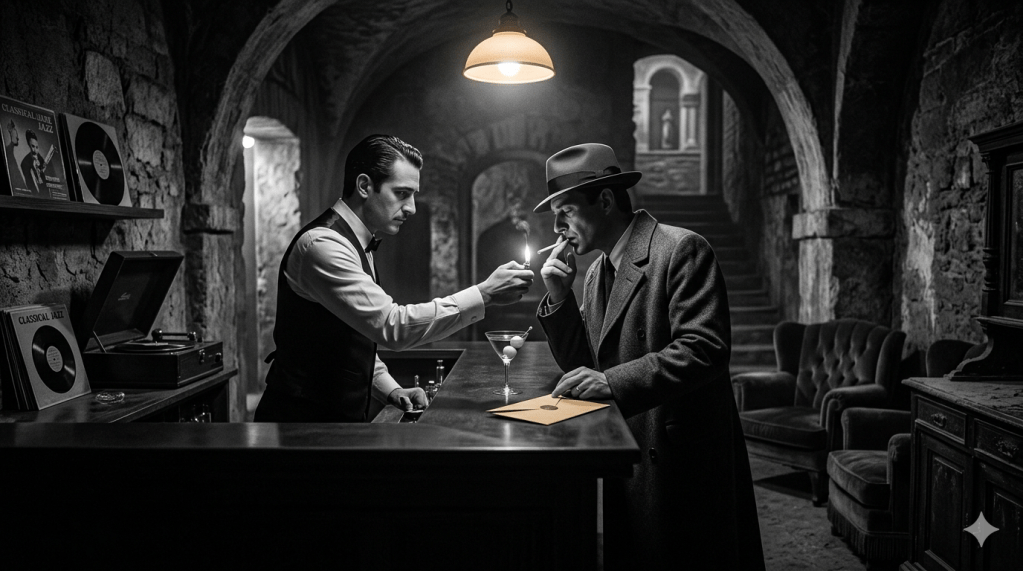
The exchange of information followed a well-rehearsed script: we would engage in small talk in front of strangers, he would ask me to light his cigarette, and in that moment, he would swiftly slide the envelope with the details into my hand. That day, after reading the subject line on the envelope, I returned behind the bar, but Mr. Gibson had vanished. His cocktail was still there, onions and all. I didn’t immediately understand where he had gone until, after a few seconds, a familiar voice filled the bar with unique, unheard-of notes.
Mr. Gibson was on stage with the jazz band: he was singing, directing the musicians with a breathtaking style. The crowd, swept up by this new musical vein, rushed to the dance floor, imitating the movements he made while singing. Once the show ended, he returned to the bar and asked for a second Gibson. I had already prepared it; he smiled, raised the glass in appreciation of the gesture, and asked me to take a break to discuss the details.
I left the bar to my colleague Cesare, and we headed down into the underground passages of the Besana. Originally catacombs and later air-raid shelters, I had furnished one of those rooms with armchairs and a small private bar for the most discerning guests. We sat down, and Mr. Gibson began to explain the mission.
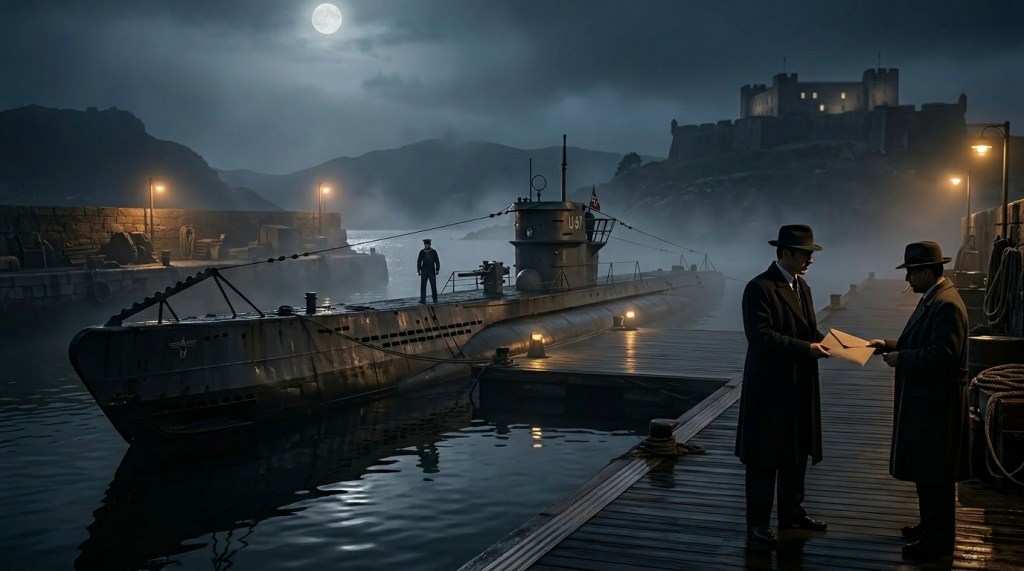
The destination was Vigo, in Galicia. A Spanish Postman had reported suspicious movements in the harbor: Nazi U-Boats that, despite the end of the war, were still docking to refuel. These movements represented a permanent threat; furthermore, several sources gave credence to Top Secret information suggesting that Hitler was still alive and fleeing toward the West. I asked how it was possible for Spain to be helping the Nazis. Mr. Gibson explained that General Franco had not signed any pacts against Germany, having received aid from the Führer during the Civil War to rise to power. Vigo, overlooking the Atlantic, was a nerve center for the expatriation of high-ranking officials to South America and for the trade of tungsten, a vital material for battleships.
The instructions were clear: infiltrating the two-day banquet at Franco’s stronghold was my only chance. I had to find evidence of the Führer’s escape and map his route into exile.
Once the briefing was over, curiosity got the better of me. I asked the Postman to tell me about himself: he knew everything about me, but I knew nothing of him. Mr. Gibson smiled, sipped his cocktail, and began his story. His real name was Stefano Nincevich, an international news journalist for twenty years. He had been recruited by his predecessor, the “Maestro” Franco Zingales.
The Maestro had met him when he was barely of age. Stefano wrote for a local newspaper with a passion for news and good drinks. One evening, at the Nottingham Forest, he saw a charming gentleman order a Gibson from Dario Comini. Stefano was intrigued, and Franco, smiling, explained the nature of that marvelous drink and how Dario was the best in town.
I noticed the deep bond between them; as he spoke, Stefano’s eyes grew misty. He told me that for a month, he had returned to the bar every night to meet Franco and talk politics over their favorite cocktail. One day, Franco and Dario took him aside, revealing they were part of J-TISBA and had chosen him as a future Postman. That was how Mr. Comini became Agent Hiro and Mr. Franco became the Maestro.
Mr. Gibson paused, took a breath, and looked at me: “You know, Diego, even if we are destined to do good, that doesn’t grant us eternity. Franco always told me that. When he left us prematurely, those were his last words. Now that Hiro, the greatest agent in history, is also gone, it is up to us to guarantee a better world for our children.”
He smiled, ate the two onions, and we went back upstairs, returning to our roles as customer and bartender. A few hours later, I left for Spain.
Diego Ferrari
“This is a work of pure fiction… except for the true parts.”
 Diego Ferrari