ITA|ENG
Upon returning from my first mission, it took several days for the reality of what had happened to sink in. I still couldn’t believe Agent Hiro was gone. Often, behind the bar counter, I would drift off, staring at the door and waiting to see his smile—stern yet sincere—appear. I realized then that everything had changed and that I had to begin a new path, a new life.
A few weeks after the war ended, Europe and Italy were struggling to pick themselves up after years of conflict and atrocity. Thanks to an old friend, word reached me that a small bar inside the de-consecrated church of the Rotonda della Besana was looking for serious and capable staff. The following day, after researching the location, I went to this monumental site situated between Via Enrico Besana and Viale Regina Margherita. The place fascinated me immediately: a great gate supported by high porticoed walls—partially collapsed from an air raid—enclosed a marvelous park. At its center stood that stunning church, known in Milan for having been the “foppone,” a communal cemetery established during the plague. As soon as I passed through the walls, I looked for the area where the bar was located.
The park was alive, filled with people who, happy for the new era and the hard-won peace, were enjoying that little island of bliss with lavish picnics and smiling children playing hide-and-seek. The bar wasn’t clearly visible from the outside, but catching sight of the sign was enough to instantly identify the entrance. An advertising board, fashionable at the time, promoted a very famous Turin Vermouth, and the word “Bottiglieria” (Bottle Shop), inscribed on the church’s outer arch, left no doubt about which way to go.
One thing, however, held me back for a moment before entering. In the park, to the left of the church near a large cedar tree, a slender young man was practicing, spinning what looked like glass bottles from a distance. The sunlight behind him allowed me to see only his silhouette, and I stood mesmerized by his acrobatic movements—decisive and precise—until a hand on my shoulder and a steady voice snapped me out of it. It was the owner of the bar; having seen me standing motionless on the threshold, focused on the boy, he asked if everything was alright. I smiled and, after apologizing, introduced myself.
The interview was brief, and the owner immediately agreed to give me a trial shift the next day. Happy with the news, I greeted him with a firm handshake and, thanking him for the opportunity, left the bar and the park to head straight home.
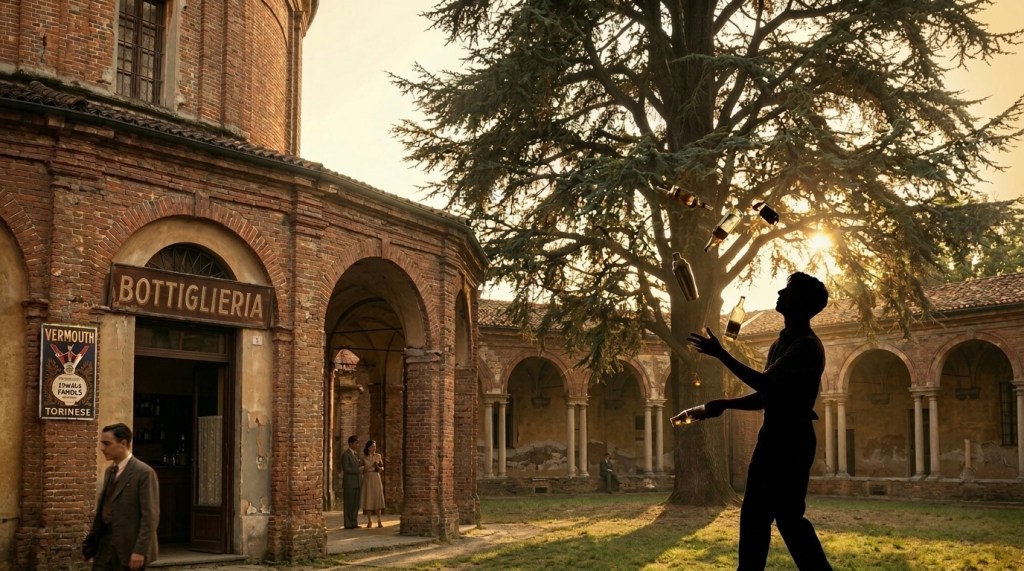
From the very next morning, my drive for professional growth led me to arrive half an hour early, but whenever I reached the door, he was always there. The silhouette boy continued to train in the park, near the cedar, always at the same hour; yet when I stepped back outside minutes later after changing, he had already vanished.
Work was going well; people, though they had few liras in their pockets, were eager to enjoy themselves. In the evenings, it was customary to serve cordials, vermouth, whiskey, or amari, but my passion for mixology led me to successfully suggest classic recipes to our regulars. Months had passed since the mission in Normandy, and no one from the Agency had been in touch. For a long time, I wondered if it had been a mere chance event, but a substantial check in my account and the Postman’s promise suggested otherwise.
It wasn’t long before, one November night, a familiar voice asked for a Gibson with two cocktail onions. I looked up slowly, with the smile of someone who knows exactly what is happening. He was there, right in front of me: the Postman had returned.
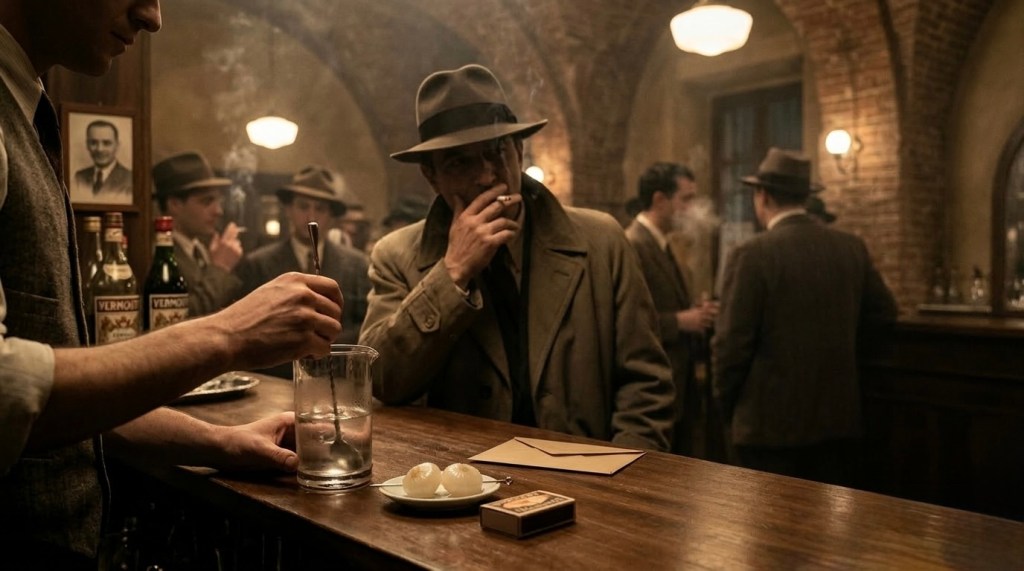
I set to work immediately, chilling the mixing glass and the coupe. While I prepared the drink, the Postman began to chat casually about this and that, remaining vague to avoid drawing the attention of the other patrons. In the bar, a band played background jazz notes, and a cloud of smoke blurred the lamps that lit the interior. The Postman, sipping his cocktail, pulled out a cigarette and, under the pretext of asking for a light, passed me an envelope containing the details of the new mission, whispering for me to step away for a few minutes to examine it. Naturally, I placed the matches and the envelope in my waistcoat pocket and took a break.
Reaching a secure area in the cellars of the Besana, I opened the letter. I was to return to France to protect General Charles de Gaulle during an electoral event; my role would be to thwart any potential attack from the opposition. The novelty, however, was that I wouldn’t be alone: this time, I would share the job with Agent Luca V., a Romanian colleague specialized in a new concept of acrobatic skills called “Flair.”
Luca V.’s task was to entertain the crowd with his performance, distracting those present, while I was to identify the targets. To neutralize the enemies, I would use a vial of Aconite—a poison derived from a mountain plant, soluble in alcohol and perfect for our line of work. The letter concluded with the arrival date in France, November 10th, and the note that I would officially meet my new colleague upon my return.
I went back to the bar and approached the Postman, who ordered another Gibson. He turned and introduced his friend, Luca Valentin, who, offering his hand like a gentleman, looked at me and smiled. His smile was dazzling and sincere. Before I could even say my name, he interrupted:
“You know, Diego, I’ve always loved the scent of cedar. It reminds me of being a child before the war, when my father would entertain my mother and me during picnics by making bottles and cutlery fly right under that tree…”
I looked down, smiling. I realized my new colleague would have a lot to teach me. We left a few days later and, on November 13th, France crowned its new President.
Diego Ferrari
“This story is entirely fictional… except for the parts that aren’t.”
 Diego Ferrari