ITA|ENG
It is incredible how, decades later, reading a book can transport your mind back to the details of a past life—to those distant days when London was my home. It feels like only yesterday when, in 2003, me and Matteo Lussana, a friend and mentor, and I would go to pick up Marco Canova. We almost always found him in the courtyard below his flat, deep in training for his Flair competitions.
For someone like me, coming from a classic bartending background and a small provincial town in Italy, that universe was a revelation. I watched Marco, fascinated, absorbing every word about a discipline that was almost entirely unknown to me at the time. He often invited us to the Roadhouse in Covent Garden, a temple for international flair competitions.It wasn’t easy to balance those visits with shifts at hotels or cocktail bars, but the impact of my first time there remains indelible.
I remember the feverish excitement of the queue at the entrance, the walk down the stairs, and the long layout of the venue, featuring a Harley Davidson embedded right in the center of the backbar. At the far end sat an immense stage with a bar station dominating the scene. The atmosphere was electric. That stage saw a rotation of talents who would soon become legends: starting with Marco himself, Tom Dyer, Christian Delpech, Nicolas Saint-Jean, and many others. The crowd erupted at every trick and, with every drop or mistake, cheered the bartender on, urging them not to give up. I was literally spellbound.
Despite having dozens of classic mixology competitions under my belt, I immediately realized that such dynamism could never be replicated in a traditional setting. In that moment, I understood the power of Flair: an art capable of uniting and entertaining. Over the years, this passion led me to support these great professionals and occasionally practice a few moves myself as a hobby.
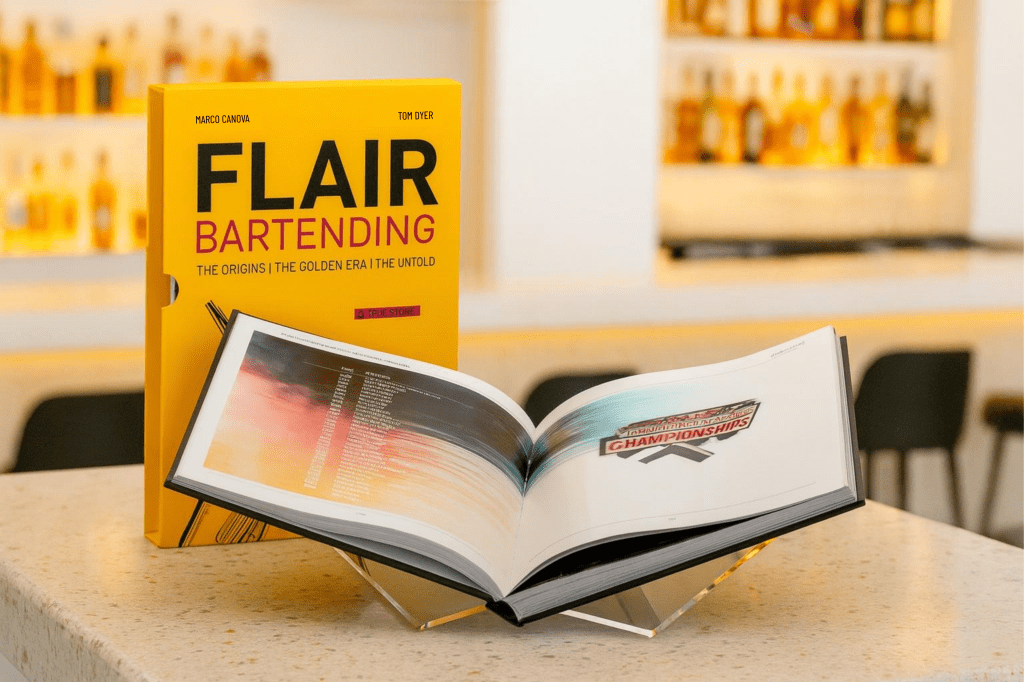
Twenty-three years after those early days, I now hold a monumental work in my hands—a true “bible” of the industry. Marco Canova and Tom Dyer have combined their expertise to create the first definitive volume on this movement: FLAIR BARTENDING – The Origin | The Golden Era | The Untold.
It is a magnificent 501-page tome, protected by a beautiful hardback cover and a slipcase. Across its 30 chapters, the authors trace different eras through meticulous research spanning several years—an essential testament for the new generation wanting to explore every nuance of this craft.
But what does this volume actually offer? First, it provides a clear classification of Working, Craft, Magic, and Exhibition Flair, supported by an indispensable glossary of movements. It then outlines the guidelines that form a bartender’s ABCs: application, training, and discipline.
The text digs deep, revealing how certain tricks have roots dating back centuries. Among the most fascinating insights, I appreciated the reference to Jan Steen’s painting (1663-1665), which depicts an innkeeper serving a customer with a perfect long pour. Furthermore, Charles Dickens’ writings from 1850 describe the acrobatic skills of New York bartenders. Even David Wondrich, a pillar of cocktail history, confirms that techniques such as throwing and the high pour were already known by the 1830s.

Significant emphasis is placed on the role of TGI Fridays, an institution that sparked the Flair phenomenon in the US and then the UK during the 1980s. It was the “home” of Flair, a global benchmark where California’s top talents worked. It is impossible not to mention the movie Cocktail: the trainer who taught Tom Cruise to flip bottles came directly from that world, marking the definitive meeting point between Hollywood and bar culture.
In the final pages, the book is enriched with details on international associations and competitions that offered incredible prizes thanks to the support of major brands. The volume gives a voice to icons of the past and present, such as Kurt Schlechter, Alexander Shtifanov, Philip Duff, Dario Doimo, Bruno Vanzan, Francesco Leoni, Tomek Malek, Luca Valentin, Rodrigo and Christian Delpech, Nicolas Saint-Jean, and, of course, the authors themselves.
I close this book with sincere emotion, grateful to Marco and Tom for taking me back to my years as an “adopted” Londoner. It is a purchase I highly recommend—both to the veterans who lived through that era and to the young newcomers eager to discover the roots of what they do.
Salute
 Diego Ferrari